loc
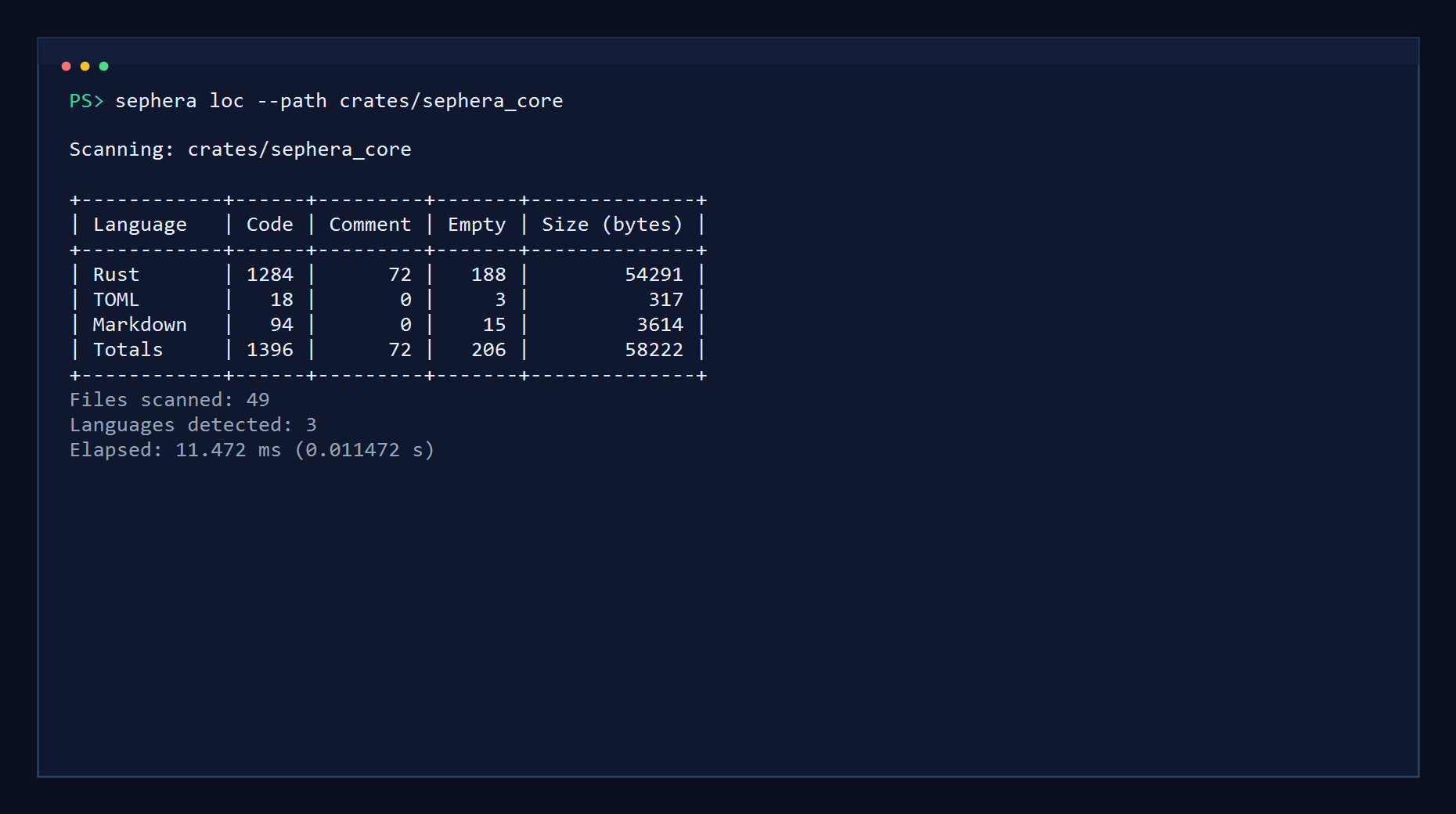
The loc command scans a directory tree, detects built-in languages, and reports:
- code lines
- comment lines
- empty lines
- size in bytes
The default output is a terminal table with per-language rows, totals, and elapsed time.
Use --path for local analysis or --url to clone and analyze a remote repository directly.
Output formats
Section titled “Output formats”--format selects the rendering, and --output writes it to a file instead of
standard output:
sephera loc --path . --format json --output reports/loc.jsonsephera loc --path . --format csvsephera loc --path . --format markdown| format | for |
|---|---|
table | a terminal; the default |
json | a dashboard or a script, with elapsed time included |
csv | a spreadsheet |
markdown | pasting into a pull request |
CSV quotes every language label unconditionally. No built-in language name contains a comma today, but a label chosen outside the tool that silently produces a wrong column count the first time it changes is worse than one that is always right.
Basic usage
Section titled “Basic usage”sephera loc --path .Analyze a remote repository directly:
sephera loc --url https://github.com/Reim-developer/SepheraAnalyze a repository tree URL:
sephera loc --url https://github.com/Reim-developer/Sephera/tree/master/cratesSample Output
Section titled “Sample Output”Scanning: crates
╭──────────┬──────┬─────────┬───────┬─────────╮│ Language ┆ Code ┆ Comment ┆ Empty ┆ Size ││ ┆ ┆ ┆ ┆ (bytes) │╞══════════╪══════╪═════════╪═══════╪═════════╡│ Rust ┆ 9724 ┆ 652 ┆ 1357 ┆ 358209 ││ TOML ┆ 113 ┆ 0 ┆ 11 ┆ 3493 ││ Markdown ┆ 69 ┆ 0 ┆ 35 ┆ 2980 ││ Totals ┆ 9906 ┆ 652 ┆ 1403 ┆ 364682 │╰──────────┴──────┴─────────┴───────┴─────────╯Files scanned: 88Languages detected: 3Elapsed: 3.909 ms (0.003909 s)sephera loc --path crates/sephera_core
fast table output with totals and elapsed time
Defaults from .sephera.toml
Section titled “Defaults from .sephera.toml”loc reads [project] and [loc] from .sephera.toml, so the format, the output
path and the ignore list do not have to be typed every time:
[project]ignore = ["vendor"]
[loc]format = "markdown"output = "reports/loc.md"sephera loc --path . # writes reports/loc.md in markdownsephera loc --path . --format json # a typed flag still winsAn unknown key in that file is an error naming the correction, not a setting that
quietly does nothing. See .sephera.toml for
profiles and aliases.
Ignore patterns
Section titled “Ignore patterns”Repeat --ignore to combine multiple patterns:
sephera loc --path . --ignore target --ignore "*.snap"Patterns containing *, ?, or [ are treated as globs and matched against both the file name and the path relative to the base, so dist/** and **/node_modules/** each exclude a whole tree. Other patterns are compiled as regexes and matched against the relative path, where an unanchored pattern such as target matches anywhere in it.
Every analysis also reads the repository’s own .gitignore and .sepheraignore, applying each one to the directory that holds it. Pass --no-gitignore to analyse the tree as it is on disk instead. Explicit --ignore patterns outrank the repository’s rules, so a pattern you typed is never undone by a ! line in .gitignore.
Progress
Section titled “Progress”loc draws a progress bar while it works, on standard error so that standard
output carries the report and nothing else:
Reading files ####>--------------------------- 3,204/8,901 (36%)The count is real, not an animation. It appears once the walk has finished and the file count is known, which is why the bar is a spinner until then — a percentage of a total nobody has counted yet would be a decoration.
--progress takes three values:
| value | behaviour |
|---|---|
auto | the default: draw only when standard error is a terminal |
always | draw even without a terminal, for a CI log or a screen recording |
never | never draw |
Nothing needs --progress never in a script. Piping or redirecting standard
error already makes auto silent, and every machine-readable format is written
to standard output, so a captured report is unaffected either way.
Remote refs
Section titled “Remote refs”For repo URLs, use --ref to analyze a specific branch, tag, or commit:
sephera loc --url https://github.com/Reim-developer/Sephera --ref v0.5.0--ref applies to repo URLs only. Tree URLs already encode the ref in the URL itself.
Notes on correctness
Section titled “Notes on correctness”Sephera’s scanner is byte-oriented and comment-token aware. It is designed to be fast, stable, and portable across newline styles, rather than to fully parse each language grammar.
In practice, that means:
- support for
LF,CRLF, and classicCR - support for the built-in comment styles declared in the language registry
- stable behavior across all supported language lookups
For the current language metadata source of truth, see config/languages.yml.