graph
The graph command uses Tree-sitter to parse native import statements across your codebase and construct a semantic dependency graph.
It supports Cycle Detection, Metric Overviews (identifying highly coupled nodes), and can export the graph to JSON, Markdown (with a Mermaid diagram), XML, or Graphviz DOT formats for downstream visualization.
sephera graph [OPTIONS]Basic Usage
Section titled “Basic Usage”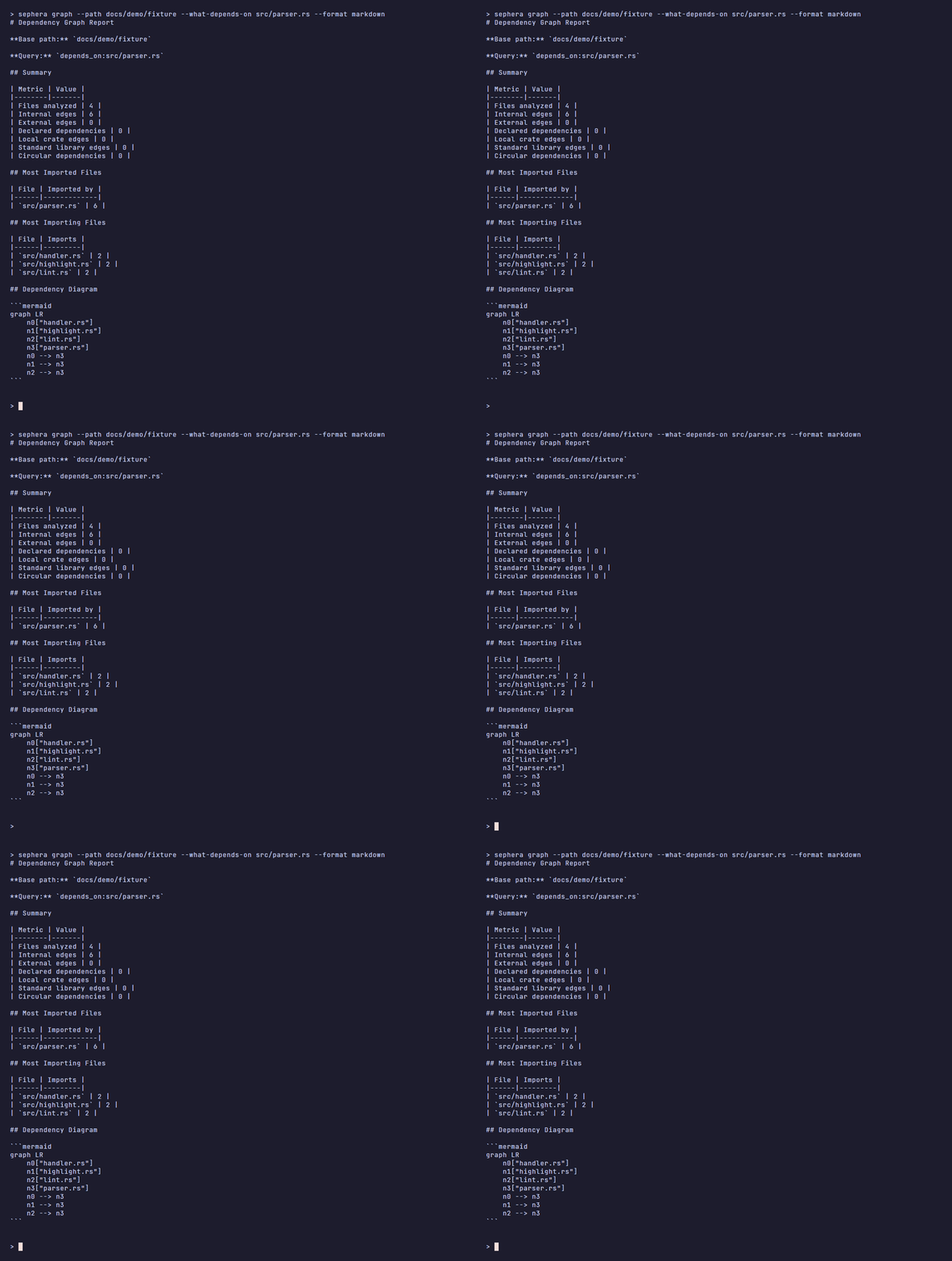
Run dependency analysis on the current directory and output to terminal as JSON (the default format):
sephera graph --path .Analyze a remote repository directly:
sephera graph --url https://github.com/Reim-developer/Sephera --format markdownAnalyze a GitHub or GitLab tree URL directly:
sephera graph --url https://github.com/Reim-developer/Sephera/tree/master/crates/sephera_core --format jsonExport a human-readable Markdown report:
sephera graph --path . --format markdown --output docs/dependencies.mdExport a Graphviz DOT file for interactive plotting:
sephera graph --path . --format dot --output deps.dotReport what a change reaches, widest blast radius first:
sephera graph --path . --diff origin/master --format markdownWhat a change reaches
Section titled “What a change reaches”--diff answers the pull-review question: instead of describing the whole
repository, it reports the blast radius of every file the change touched,
sorted so the file whose change would break the most is first.
sephera graph --path . --diff HEAD~1 --format jsonIt accepts a ref (HEAD~1, origin/master) or the keywords working-tree and
staged, with the same meanings context --diff gives them.
The graph is built once and each changed file is measured against it, so the cost does not grow with the size of the diff. Deleted files are skipped and listed separately, because a file that no longer exists has no blast radius and reporting it as “0 dependents” would put a line in a review that reads like a finding.
For a single file rather than a change, impact is the
direct route.
Failing a build
Section titled “Failing a build”Two thresholds turn the report into a gate. Both print the report as usual and change only the exit code.
# Exit 2 at the first import cyclesephera graph --path . --fail-on-cycles 1
# Exit 2 when the resolver cannot place the project's own import pathssephera graph --path . --fail-on-unresolved 1
An unresolved local path was meant to name a file in this project and was not found. That is a resolver gap, not a dependency, and a blast radius that counts one silently omits a file.
Exit code 2 means a threshold was crossed; 1 means the analysis could not run. Keeping them distinct means a broken install does not look like a violated rule in a log.
Sample Output
Section titled “Sample Output”# Dependency Graph Report
**Base path:** `crates/sephera_cli`
## Summary
| Metric | Value ||--------|-------|| Files analyzed | 29 || Internal edges | 89 || External edges | 160 || Declared dependencies | 104 || Local crate edges | 1 || Standard library edges | 55 || Circular dependencies | 0 |
`Unresolved local paths` and `Feature-gated edges` appear only when non-zero. The first counts imports meant for this project that the resolver could not place; the second counts edges that only compile when a `#[cfg]` is on, so a blast radius that counted them silently would claim a dependency the build may not have.
## Dependencies
| Package | Kind | Version | Import paths ||---------|------|---------|--------------|| `std` | stdlib | unknown | 55 || `sepheracore` | declared | unknown | 37 || `anyhow` | declared | unknown | 17 || `tempfile` | declared | unknown | 12 || `sephera` | workspace | unknown | 1 |
Unresolved edges are attributed to real packages by reading the manifests at the base path: `Cargo.toml` and `Cargo.lock`, `package.json`, `go.mod`, `requirements.txt`. This separates three things that all used to be counted as one "external" number:
- **declared** — named by a manifest, so a version is known when the lockfile records one- **workspace** — a crate in this repository, reached by name rather than by path- **stdlib** — provided by the language, so there is nothing to manage
Versions resolve when a lockfile is found at the base path. Analysing a subdirectory therefore reports `unknown`, because the manifest sits above the path given to `--path`; point `--path` at the repository root to get them.
## Most Imported Files
| File | Imported by ||------|-------------|| `src/args.rs` | 20 || `src/context_config/types.rs` | 16 |
## Most Importing Files
| File | Imports ||------|---------|| `src/run.rs` | 25 || `src/context_config/resolve.rs` | 17 || `src/context_config/load.rs` | 5 |
## Dependency Diagram
```mermaidgraph LR n0["args.rs"] n1["budget.rs"] n2["context_config.rs"] %% ... remaining edges and nodes ...Options
Section titled “Options”--path <PATH>
Section titled “--path <PATH>”The root directory of the codebase to analyze locally. Defaults to the current working directory when --url is not provided.
--url <URL>
Section titled “--url <URL>”Clone and analyze a remote repository directly.
- supports cloneable repo URLs such as HTTPS, SSH, SCP-style
git@host:org/repo.git, andfile:// - supports GitHub tree URLs like
https://github.com/org/repo/tree/ref/subdir - supports GitLab tree URLs like
https://gitlab.com/group/project/-/tree/ref/subdir - tree URLs scope the analysis to the pointed subdirectory, so
--focusand--what-depends-onstay relative to that subtree
--path and --url are mutually exclusive.
--ref <REF>
Section titled “--ref <REF>”Check out a specific branch, tag, or commit before analysis.
sephera graph --url https://github.com/Reim-developer/Sephera --ref v0.5.0 --format markdown--ref only applies to repo URLs. Tree URLs already encode the ref in the URL and reject --ref.
--focus <PATHS...>
Section titled “--focus <PATHS...>”One or more relative paths to focus the analysis on. If provided, Sephera treats matching files as traversal roots and includes their dependency subgraph.
Paths are resolved relative to the selected analysis base:
- local
--path - the repo root for repo URLs
- the tree subdirectory for tree URLs
sephera graph --path . --focus crates/sephera_core crates/sephera_cli--what-depends-on <PATH>
Section titled “--what-depends-on <PATH>”Finds all files in the repository that import the specified file. Useful for assessing the impact of changing a core utility file.
sephera graph --path . --what-depends-on src/utils.tsThe path must resolve to an analyzed file inside the selected analysis base. When this flag is set, Sephera traverses the graph in reverse from the target node instead of following normal imports outward.
The direct and indirect lists are disjoint: a file that imports the target directly is not also counted among those that reach it indirectly, and the target itself is never listed as importing it. Both were once counted twice, which made the section report a total larger than the number of files involved.
For the same answer as a standalone command, see impact.
--diff <SPEC>
Section titled “--diff <SPEC>”Report the blast radius of every file changed against a Git base.
sephera graph --path . --diff origin/master --format markdownMutually exclusive with --what-depends-on, which answers about one named file
rather than about a change.
--fail-on-cycles <COUNT> / --fail-on-unresolved <COUNT>
Section titled “--fail-on-cycles <COUNT> / --fail-on-unresolved <COUNT>”Exit 2 at or above the given count. The limit is the first failing value,
so --fail-on-cycles 1 fails on a single cycle. Zero is rejected by the parser,
because a limit of zero would fail every run including the clean ones.
sephera graph --path . --fail-on-cycles 1 --fail-on-unresolved 1--depth <DEPTH>
Section titled “--depth <DEPTH>”Maximum traversal depth applied when --focus or --what-depends-on is active. Defaults to unlimited.
0: keep the traversal roots plus their direct neighbors1: include one more transitive hop- omitted: include the full reachable subgraph
When neither --focus nor --what-depends-on is provided, Sephera returns the full graph and ignores --depth.
The number is the number of hops from the traversal root, which is always
included. On a chain c → b → a → target:
--depth | reached |
|---|---|
0 | target |
1 | target, a |
2 | target, a, b |
3 | target, a, b, c |
sephera impact --depth counts hops the same way, so the same flag number bounds
the same walk on both commands.
--format <FORMAT>
Section titled “--format <FORMAT>”The output format to generate.
json(default): A structured JSON document containing metrics, lists of nodes, and edges.markdown: A human-readable Markdown report including statistics, circular dependency warnings, and a top-levelmermaiddiagram.xml: Structured XML representation (useful for LLM agent integration).dot: A valid Graphviz DOT representation.
--output <FILE>
Section titled “--output <FILE>”Write the generated report to the specified file path instead of standard output. If the file exists, it will be overwritten.
--ignore <PATTERNS...>
Section titled “--ignore <PATTERNS...>”Additional patterns to exclude during traversal, applied after the patterns found in .gitignore and .sepheraignore. Globs match both the file name and the path relative to the base, so dist/** and **/node_modules/** each exclude a whole tree. Pass --no-gitignore to analyse the tree as it is on disk, which counts everything the repository excludes.
URL Mode Notes
Section titled “URL Mode Notes”- Repo URLs are cloned into a temporary checkout for each invocation.
- Report output keeps the logical URL or tree URL as the base path instead of leaking the temp checkout path.
- Tree URLs analyze only the referenced subdirectory.
graphURL mode supports repo URLs plus GitHub and GitLab tree URLs. Blob URLs are intentionally rejected.
Supported Languages
Section titled “Supported Languages”Sephera’s graph engine currently extracts import statements from:
- Rust
- Python
- TypeScript
- JavaScript
- Go
- Java
- C
- C++
How It Works
Section titled “How It Works”- Traversal: Sephera walks the target directory, honoring ignore rules and collecting analyzable source files.
- Extraction: It applies language-specific Tree-sitter parsing to extract
use,import,require, andincludedirectives. - Resolution: It resolves internal imports to canonical file paths across the repository, including Rust module paths and Python relative imports.
- Selection: It optionally narrows the full graph by focused entry points, reverse dependency queries, and traversal depth.
- Cycle Detection: It runs cycle detection on the final in-scope internal graph.
- Rendering: Output is routed to the corresponding format generator, with selection metadata included in JSON, Markdown, and XML.
Circular Dependencies
Section titled “Circular Dependencies”If Sephera detects circular dependencies (where File A imports File B, which loops back to A), they will be explicitly flagged in the markdown, json, and xml metric reports to help you refactor tightly coupled sub-systems.